ServicesEquipment Installation
Loading Dock Equipment Installation in Tamaqua
We install dock levelers, vehicle restraints, bumpers and dock doors after measuring your pit, dock height and the trucks you actually receive. You get written findings first, then equipment that fits the opening and an install scheduled around your shipping.
Equipment That Fits the Dock You Have
Most installation problems start before the first bolt. A leveler with too little lip reach for your trailers, a restraint that cannot catch a lift-gate truck, or a pit with cracked curb angles will cause trouble no matter how well the unit is built. So every install starts with an inspection of the dock as it stands: pit depth and width, the condition of the embedded steel, the concrete around it, the electrical supply and the range of bed heights at your doors.
From there we tell you plainly what the dock can support and what has to change first. Sometimes that means a straight swap into an existing pit. Sometimes the pit needs repair, a new curb angle or a different leveler style. You see the reasoning before you commit to anything.
What an Installation Covers
Dock levelers
Hydraulic, mechanical and air-powered pit levelers, plus edge-of-dock units for light, low-volume doors. We match capacity and lip length to your heaviest loads and your trailer height spread, not just the old unit's nameplate.
Vehicle restraints
Wheel-based and rear-impact-guard restraints, mounted to the dock face and wired to inside and outside signal lights. Where you want it, we interlock the restraint with the leveler or the overhead door so the sequence cannot be skipped.
Pit and steel work
Removal of old equipment, cleaning out the pit, repairing spalled concrete and replacing or re-welding curb angles. A leveler is only as solid as the steel it is welded to.
Bumpers and dock doors
Laminated rubber or steel-faced bumpers set to the right projection, and overhead doors or high speed doors fitted to the opening. The bumper projection and the leveler lip have to agree, or trailers hit the dock face.
Controls, wiring and testing
Push-button stations, power units and interlocks are wired and checked. Every unit is cycled under load before we hand it back to your crew.
Signs It Is Time for New Dock Equipment
The lip no longer reaches
Your carriers' trailers sit higher or lower than the leveler can bridge, so forklifts bottom out or drivers stack plywood to make the transition.
Repairs keep coming back
Cracked deck plates, worn hinge pins and leaking hydraulic cylinders on an older unit can cost more in parts and downtime than a replacement over a few years.
Trailers creep away from the dock
If you rely on wheel chocks alone, or drivers pull out early, a vehicle restraint closes a real safety gap.
The pit is coming apart
Broken curb angles and crumbling concrete at the pit edge mean the leveler is losing its anchor. Freeze and thaw cycles and road salt dragged in by trucks make this worse each winter.
You are adding or reconfiguring doors
New doors, a change in the type of trucks you receive, or a move from manual to hydraulic operation all call for a measured install.
The Steps of an Installation
- 1
Measuring the dock on site
At every door we record the pit size, dock height, door opening and the spread of trailer bed heights you receive. We also look at the concrete, the embedded steel and the power available, taking photos as we go.
- 2
A written report and our advice
We write up the condition of the dock in plain terms along with the equipment that suits it, listing any pit or electrical work on its own. When repairing an existing unit makes more sense, we tell you.
- 3
Planning around your trucks
We schedule one door at a time so freight keeps moving through the others. Pit repairs that need concrete to cure are timed so a busy door is never left with an open pit.
- 4
The install itself
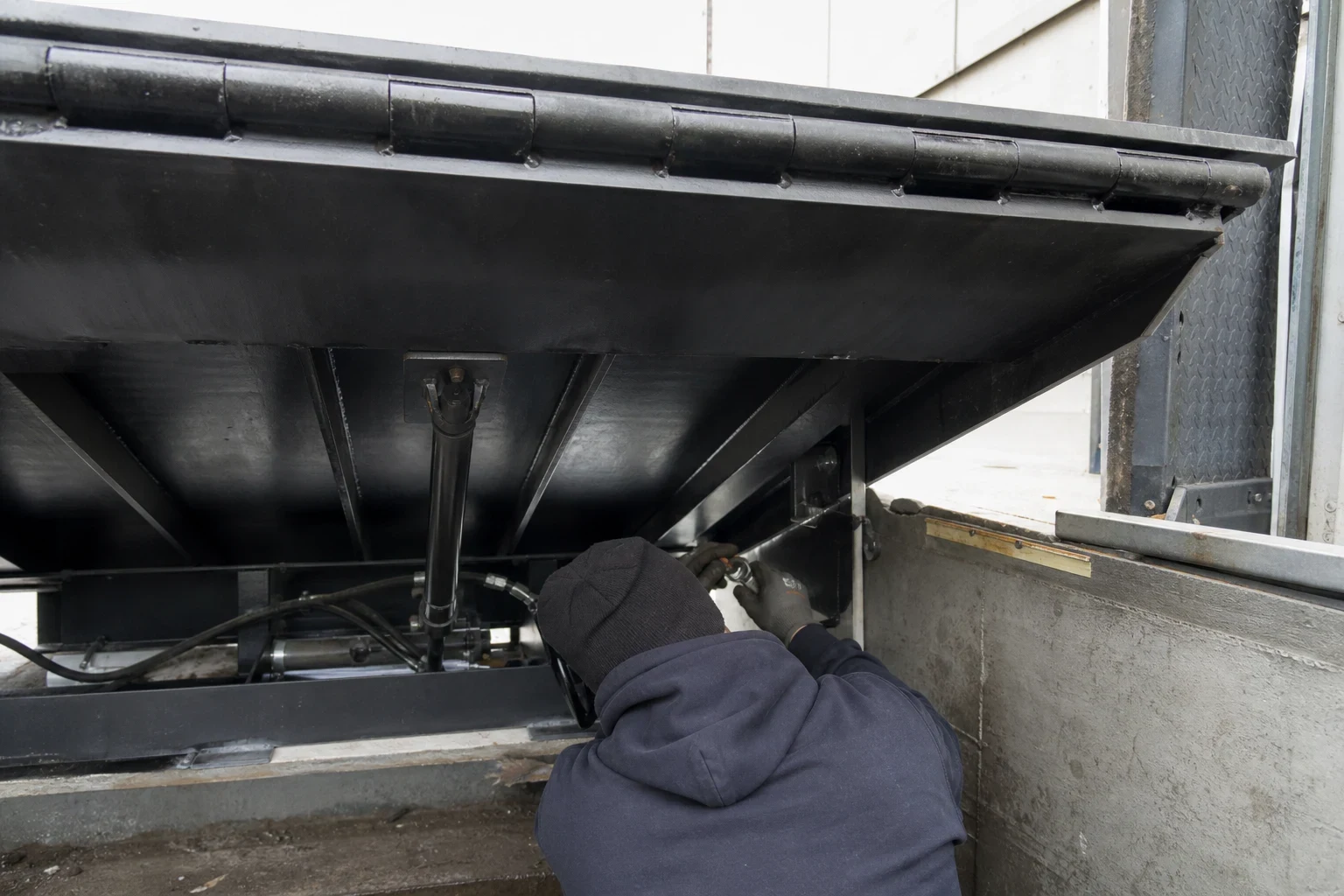
Setting heavy levelers and working up high on doors and lights is part of the job, and our crew holds forklift and scissor lift training certification for it. We pull the old unit, prepare the pit, set and weld the new equipment, anchor it and wire up the controls.
- 5
Final checks and handoff
Each unit runs through its full travel while we check the interlocks and lights, and we show your operators the right order of use. Then we clean up and haul the old equipment away.
What Moves the Price of an Install
No two docks start from the same condition, so the price comes from what the inspection finds. We put each part of the job on its own line so you can see where the cost sits and what is optional.
- Equipment type and capacity
- A hydraulic leveler with a long lip and high capacity costs more than a mechanical unit sized for lighter loads. Restraint style and interlock options also change the number.
- Condition of the pit
- A clean, square pit with sound curb angles is a straightforward swap. Concrete repair, new embedded steel or re-forming a pit adds labor and cure time.
- Electrical work
- Hydraulic levelers, restraints and powered doors need the right supply at the door. Running new circuits or control wiring adds to the job.
- Number of doors and sequencing
- Several doors done in one mobilization are more efficient. Work staged around tight shipping windows can take more visits.
- Removal and permits
- Pulling and hauling old equipment is part of most jobs. Where structural or electrical work requires a permit, we account for it up front.
Installation Questions
Something not covered here? (570) 565-0322
Can a new leveler go into our existing pit?
Often, yes. Many levelers are built to standard pit sizes, but older pits vary and the curb angles may be worn. We measure the pit and check the steel before recommending a drop-in unit, so you know if any pit work is needed.
How long will a door be out of service?
It depends on what the pit needs. A straight replacement into a sound pit is a much shorter job than one that needs concrete repair and cure time. Once we have measured the dock, we tell you the expected downtime per door so you can plan receiving around it.
Do you install equipment we already bought?
We can, after we look over the unit and the dock it is going into. If it does not fit the pit or your trailer heights, we will tell you before installing it. If you have not bought yet, our Loading Dock Equipment Sales page covers how we help choose equipment.
What warranty comes with the installation?
Our installation work carries a 1-year labor warranty. Equipment coverage comes from the manufacturer and depends on the unit you choose.
Should we add a vehicle restraint when we replace the leveler?
It is worth considering at the same time, since the dock face and wiring are already being worked on. A restraint interlocked with the leveler keeps a trailer from pulling away while a forklift is on the plate. We explain the options on our Vehicle Restraints page and during the site visit.
How do we keep new equipment working?
Regular checks of hydraulic fluid, hinge pins, lip springs and restraint hooks catch wear early. Our Loading Dock Preventative Maintenance service covers this on a schedule that suits your traffic.
Start With a Look at Your Dock
Tell us how many doors you have and what you receive, and we will set up an inspection. You get measured findings before any equipment is recommended, for facilities in Tamaqua and nearby towns like Lehighton and Hazleton.