ServicesVehicle Restraints
Vehicle Restraints in Tamaqua
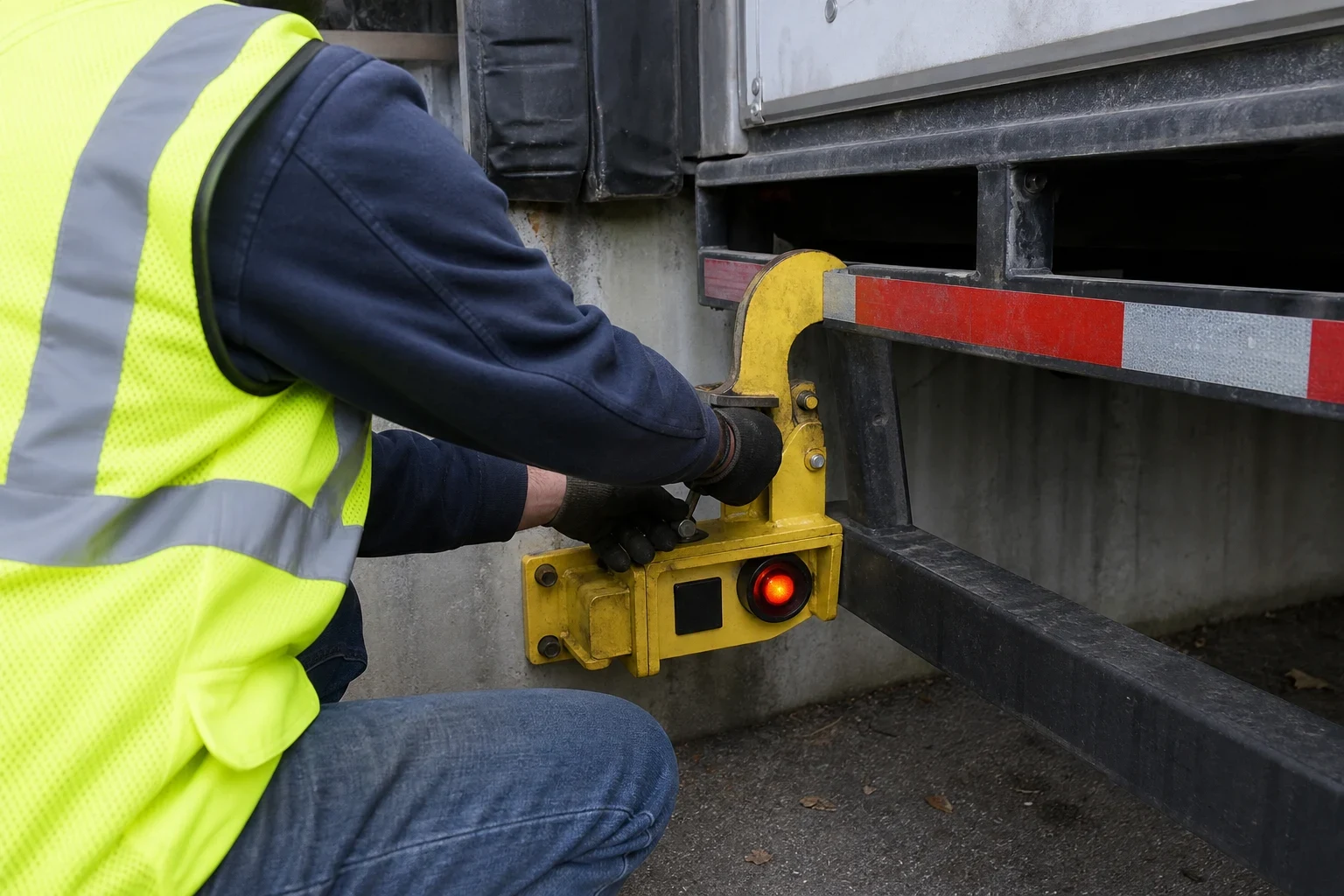
A vehicle restraint keeps a trailer from creeping or pulling away while a forklift is inside it. We inspect the hook, carriage, sensors and signal lights, show you exactly what we found, and then repair or replace only what the findings support.
What a restraint does, and when it needs attention
Most dock restraints are one of two types. Hook-style units ride a carriage up the dock face and rotate a steel hook over the trailer's rear impact guard, often called the ICC bar. Wheel-based units lock a barrier against the trailer's rear tire, which helps when the bar is damaged, missing or set too high or low for a hook to reach.
Either way, the restraint is only as good as its signals. The red and green lights inside and out tell your driver and your forklift operator whether the trailer is actually held. When a sensor or limit switch fails, the lights can show green with nothing engaged. That is the failure we look for first, because it leads to trailer separation and forklift falls.
We service restraints at warehouses, distribution centers, manufacturers and retail receiving docks. Before we quote anything, we run the unit through full cycles, measure wear, and write down what is worn, what is broken and what is still fine.
What our restraint work covers
Hook and carriage service
We check the hook for bending and cracked welds, examine the carriage rollers and track for binding, and test the return springs that keep the carriage pressed against the ICC bar as the trailer rises and settles during loading.
Wheel restraint repair
On wheel-based units we look over the barrier arm, drive chain or hydraulic cylinder, and the ground track. Debris and packed ice in the track are a common reason these units stall partway out.
Lights, sensors and controls
We test the inside and outside signal lights, limit switches, proximity sensors and the control panel. Every fault gets traced to a cause, whether that is a failed switch, a chafed wire or a corroded connector.
Interlocks with your leveler and door
Many facilities tie the restraint to the dock leveler and overhead door so neither can operate until the trailer is held. We confirm those interlocks still work in the right order, and we can add them where they were never wired.
Hydraulic and electrical components
For hydraulic units we check the pump, fluid level and hoses for leaks. For electric units we check the motor, gearbox and brake.
New restraint installation
When a unit is beyond repair, we install a replacement matched to your trailer mix and dock height. Our techs are forklift and scissor lift training certified, which matters when work runs at the dock face with traffic nearby.
Signs your vehicle restraint needs service
Green light with no engagement
If the lights say the trailer is held but the hook is not over the bar, a sensor or switch has failed. Take that door out of use until it is checked.
Hook won't reach the bar
Weak carriage springs, a bent hook or a seized roller keep the hook from rising to the ICC bar. Drivers end up relying on wheel chocks alone.
Slow, noisy or stalled cycles
Grinding, chattering or a unit that stops mid-travel points to a worn gearbox, low hydraulic fluid or a jammed track.
Rust and pitting on the carriage
Winter salt and slush carried in on trailer undercarriages eat at the lower dock face. Heavy corrosion on the carriage or track weakens the parts that hold the load.
Alarms or overrides in daily use
If crews routinely bypass the restraint to keep trucks moving, the unit has a problem worth finding instead of working around.
How a restraint service visit runs
- 1
Talk it through by phone
You tell us the brand if you know it, the type, and what the crew is seeing. We schedule a time that keeps the fewest dock doors out of service.
- 2
Inspect and cycle the unit
We lock out the restraint, go over the mechanical and electrical parts, then cycle it with and without a trailer if one is available. We note measurements and take photos of worn or damaged parts.
- 3
Plain findings and options
You get a written list of what we found and what each item means for safety. Where repair makes sense we say so, and where replacement is the honest answer we explain why.
- 4
Repair, test and hand back
After you approve the work, we make the repair, run the restraint through repeated cycles, confirm the lights and interlocks, and walk your lead through the result. Our labor carries a 1-year labor warranty.
What moves the cost of restraint work
Restraint pricing depends on what the inspection turns up, so we quote after we have seen the unit. You get the parts and labor listed separately, and nothing is added without your approval.
- Restraint type and brand
- Hook-style, wheel-based, hydraulic and electric units use different parts. Some brands have parts on hand quickly, others take longer to source.
- Extent of the damage
- A failed limit switch is a small job. A bent carriage, cracked mounting plate or a damaged dock face behind it is a much larger one.
- Interlock and wiring work
- Tying a restraint into an existing dock leveler and overhead door means control changes and new wiring runs, which adds labor.
- Number of doors and access
- Servicing several doors in one visit is more efficient than single trips. Tight approaches or live traffic during work can slow the job.
Vehicle restraint questions
Something not covered here? (570) 565-0322
Are wheel chocks enough, or do we need a restraint?
Chocks can work, but they depend on a driver placing them every time, and they can slide on ice or wet pavement. A powered restraint engages from inside and gives both sides a visible signal. We can look at your docks and tell you which approach fits your traffic and trailer mix.
Can you repair a restraint made by another manufacturer?
Yes. We work on common hook-style and wheel-based units regardless of who installed them. If a part is no longer made, we will tell you that during the inspection rather than after we start.
Will our dock door be out of service all day?
Usually not. Many repairs, like switches, lights and springs, are done within a single visit. Larger jobs such as a carriage replacement may take longer, and we plan around your busiest shipping hours.
What warranty comes with the repair?
Our restraint repairs and installations come with a 1-year labor warranty. Parts coverage depends on the manufacturer, and we tell you what applies before the work starts.
Can you add a restraint to a dock that never had one?
Often, yes. We check the dock face, the bumper projection and the approach to make sure a unit can mount and reach your trailers. Our Loading Dock Equipment Installation page covers that work in more detail.
Find out what your restraints are really doing
We will look over the hook or wheel unit, its lights and interlocks, and tell you plainly what needs work. Restraint checks also fit into our Loading Dock Preventative Maintenance visits.